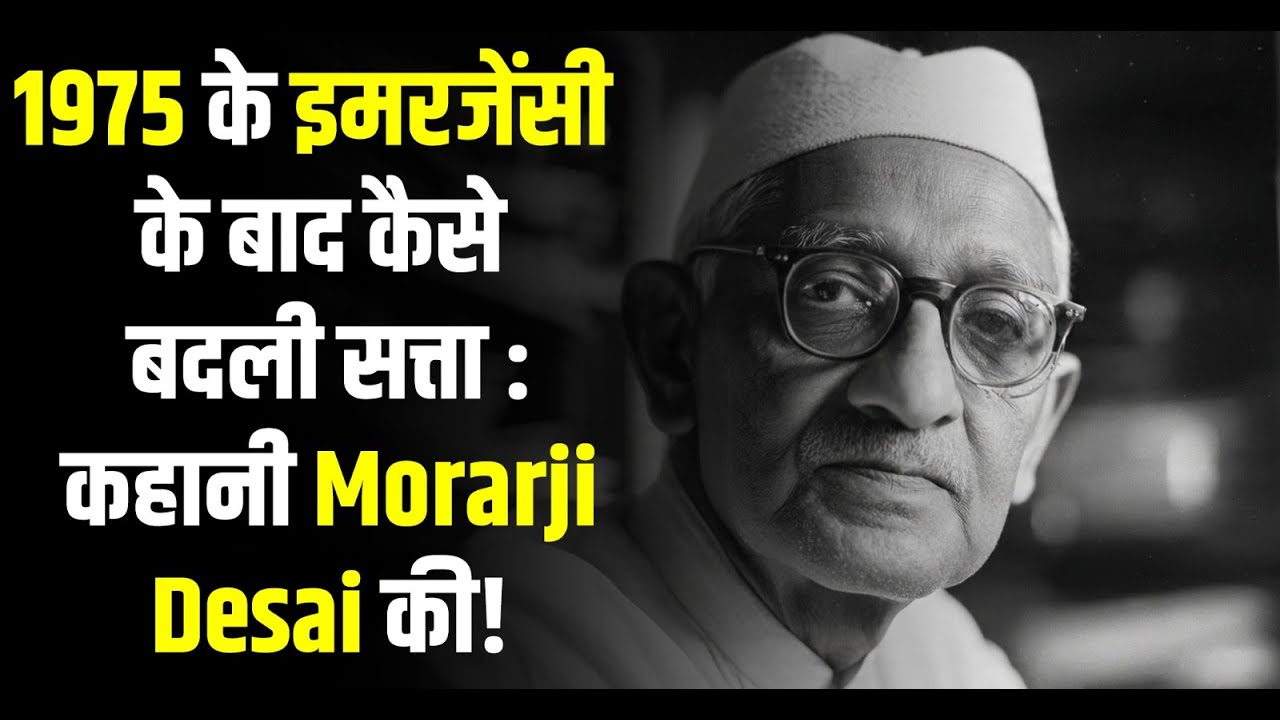
In the wake of the 1975 Emergency, India was a nation fractured, grappling with the erosion of democratic principles and the suppression of fundamental rights. The period, marked by censorship, political imprisonments, and a climate of fear, left an indelible mark on the Indian psyche. Amidst this upheaval, a familiar figure re-emerged from the political shadows: Morarji Desai. His journey after the Emergency offers a compelling study of resilience, political maneuvering, and the complex process of rebuilding a nation's faith in its democratic institutions.
Seeds of Discontent: Pre-Emergency Realities
To understand Desai’s post-Emergency trajectory, one must first recognize the context of the Emergency itself. Economic hardships, rising social unrest, and perceived governmental overreach had created a volatile political climate. Then Prime Minister Indira Gandhi's decision to impose Emergency rule, citing internal disturbances, shocked the nation. Critics argue that the move was an autocratic attempt to consolidate power. The opposition, including figures like Desai, faced imprisonment and systematic silencing.
The Aftermath: Charting a New Course
Following the lifting of the Emergency in 1977, India experienced a seismic political shift. The ruling Congress party, weakened by its actions during the Emergency, faced a resurgent opposition, galvanized by the perceived injustices. The people, desperate for change, overwhelmingly voted against the Congress, paving the way for a coalition government – the Janata Party – led by Morarji Desai.
-
Unifying the Opposition: Desai played a pivotal role in bringing together diverse political factions, including the Bharatiya Jana Sangh, the Congress (O), and the Socialist parties, to form the Janata Party. This coalition, while fragile, presented a united front against the Congress.
-
The Prime Minister's Seat: Desai, at 81, was sworn in as Prime Minister of India, becoming the first non-Congress Prime Minister. This marked a watershed moment in Indian politics, signifying a clear rejection of the Emergency and the Congress’s dominance.
-
Restoring Democratic Principles: One of the Janata government’s primary goals was to dismantle the oppressive laws enacted during the Emergency and restore civil liberties. Freedom of the press was re-established, and political prisoners were released.
-
Economic Policies: The Desai government focused on rural development, promoting small-scale industries and prioritizing agricultural growth. However, economic challenges persisted, compounded by internal divisions within the coalition and a lack of clear economic direction.
-
Internal Conflicts and Instability: The Janata Party, an amalgamation of disparate ideologies, was inherently unstable. Frequent internal squabbles, power struggles, and ideological clashes plagued the government, ultimately leading to its collapse in 1979.
-
Short-Lived Success: Despite its tumultuous tenure, the Janata government, and Desai's leadership, played a crucial role in re-establishing democratic norms. This was significant in ensuring free and fair elections, and by opening up the political space for the emergence of new parties and voices.
Analysis: A Legacy of Contradictions
Experts analyzing the Desai years have offered mixed assessments. "He was a man of strong convictions and unwavering principles, particularly regarding austerity and morality in public life," noted one political commentator, pointing towards Desai's efforts to promote Gandhian ideals and curb corruption. However, his rigid personality and the ideological fragmentation within the Janata Party often hampered effective governance.
Another perspective suggests that the sheer number of different parties in the Janata party made it difficult for Desai to find allies who could help him with his plans. The various parties had different ideologies and differing views on policy. This made consensus-building difficult, ultimately contributing to the government's instability.
Critics argue that Desai’s policies were often too conservative and that his government failed to address some of the pressing social and economic issues of the time with sufficient urgency. A tech industry analyst noted that Desai’s government lacked a cohesive economic vision, which led to policy inconsistencies and further economic challenges.
The Enduring Significance
Morarji Desai’s post-Emergency story is more than just a historical narrative; it is a lesson in the complexities of democracy and the fragility of political alliances. He showed resilience to be a leader for the nation after the Emergency. He helped re-establish a democratic tradition for India. His era highlights the importance of checks and balances, the dangers of authoritarianism, and the challenges inherent in building consensus across diverse political landscapes. His legacy serves as a reminder of the constant vigilance required to safeguard democratic values and the enduring human struggle to build a just and equitable society. The Janata government's ultimate failure also offered valuable lessons for future political parties, underscoring the necessity of strong leadership, ideological cohesion, and effective governance to overcome internal divisions and provide sustained stability.